AI Candidate Screening: From Inbound CV to Interview in 45 Seconds
How an n8n and AI pipeline cuts candidate vetting from 3 days to 45 seconds. Saves 12+ recruiter hours weekly under human supervision.
The Bottleneck: Why Manual Candidate Vetting Fails to Scale
When engineering hiring surges, recruiting teams quickly hit three major operational bottlenecks:
- Format Clutter & Admin Fatigue: Inbound resumes arrive in scattered formats (multi-column PDFs, Word docs, email text). Recruiters spend up to 25 minutes per applicant just extracting information and logging records.
- Unverified Technical Claims: Non-technical recruiters often struggle to confirm whether claimed framework experience reflects real coding ability, allowing resume buzzwords to pass while missing top engineers.
- Losing Top Talent to Delay: In competitive tech markets, great developers accept competing offers while waiting 3–5 business days just to hear back from a first-round application.
Operational Impact: With 40 applicants each week, the team spent 15+ hours on manual data entry. That equaled two lost workdays per week that recruiters needed for interviews or sales lead triage.
The Solution: Automated Screening with Human-in-the-Loop Control
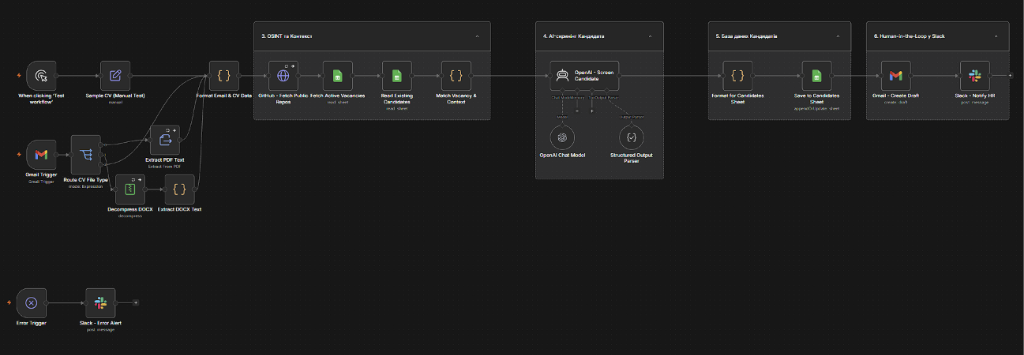
Instead of relying on rigid third-party software, this custom workflow automates repetitive screening steps while keeping hiring managers in 100% control:
flowchart LR
    A["Inbound Application"] --> B["Smart Resume Extraction"]
    B --> C["Live GitHub Code Verification"]
    C --> D["Candidate Fit Scoring"]
    D --> E["Database & Draft Preparation"]
    E --> F["1-Click Slack Review Card"]
How the Workflow Operates:
- Ingest applications: Captures resumes from emails or web forms and extracts clean text without manual copying.
- Verify technical skills: Locates the applicant’s public GitHub profile. It checks recent commit frequency, active languages, and repository quality.
- Score candidate fit: Compares experience with the job description using self-hosted AI infrastructure and applies consistent evaluation rules.
- Prepare interview slots: Suggests 3 open calendar times in the recruiter’s timezone and creates a ready Gmail draft.
- Send Slack approval card: Delivers a candidate summary card to Slack with two buttons: Approve & Send or Reject & Archive.
Why It’s Built for Business Operations
1. Zero Rogue Actions (Human-in-the-Loop)
AI handles the tedious research and drafting, but humans make the final decisions. The system never contacts an applicant autonomously. With a single click in Slack, recruiters review the match summary and dispatch the invitation instantly without opening an email tab.
2. Live Skill Verification Over Resume Buzzwords
Anyone can list modern tech stacks on a CV. By checking live open-source code and commit history on GitHub, the system gives recruiters an objective snapshot of real coding activity before booking expensive technical interview loops.
3. Enterprise Safety & Data Protection
The system treats external documents with zero trust. XML tags isolate resume text to block prompt injection attacks. All data is sanitized before entering CRM pipelines and databases.
Client Voice & Operator Feedback
What the Lead Technical Recruiter observed:
“Before this workflow was active, I spent half my week digging through GitHub commits and copying candidate data into spreadsheets. Now, I get an interactive card in Slack with verified code activity and a pre-slotted interview invitation. I click ‘Approve’, and the interview is booked. It feels like having an extra full-time senior technical sourcer on the team.”
Measured Business Impact & ROI
| Operational Metric | Before Automation (Manual) | After Implementation (Autonomous) | Measurable Business Impact |
|---|---|---|---|
| Response Turnaround | 3 business days | < 45 seconds | 98% faster candidate outreach |
| Recruiter Review Time | 25 mins / candidate | 2 mins / candidate | 12+ hours saved weekly |
| Interview Scheduling | 4–6 email exchanges | 1-click pre-slotted draft | Zero scheduling friction |
| Data Organization | Manual, inconsistent sheets | 100% organized data | Zero duplicate evaluations |
| Application Capacity | Strained at 40 apps/week | Scalable to 500+ apps/week | Grow hiring without extra staff |
Bottom Line: The team reclaimed 12+ hours every week to focus on active sourcing and in-depth interviews, while shortening the hiring cycle by 72 hours per qualified candidate.
Frequently Asked Questions
Does the AI ever send emails to candidates without human approval? ▼
Never. The system strictly follows a Human-in-the-Loop (HITL) model. The AI drafts a personalized invitation in Gmail and posts a summary card to Slack. An email is only sent when a team member clicks 'Approve & Send'.
How does the system verify a developer's real skills? ▼
The workflow automatically checks the candidate's public GitHub profile, reviewing recent code commits, active languages, and repository quality to verify practical skills beyond resume buzzwords.
How does the pipeline handle unexpected resume formats or corrupted files? ▼
If a resume cannot be parsed due to file corruption or encryption, the system routes it to a dedicated triage channel in Slack with an alert for quick manual review, ensuring no applicant is lost.
Can this system connect to ATS platforms like Greenhouse, Lever, or HubSpot? ▼
Yes. The pipeline produces clean, standardized records that can be directed to any modern ATS or CRM, replacing or supplementing spreadsheet storage seamlessly.
How many hours did your team spend on manual qualification & triage this week?
Every hour spent copying data between CRMs, sorting inbound resumes, or writing routine intro emails is an hour lost from closing high-ticket deals. Let's eliminate the bottleneck.